1. 2026 Top Search Trends & Core Pain Points of 5-Axis Machining Buyers
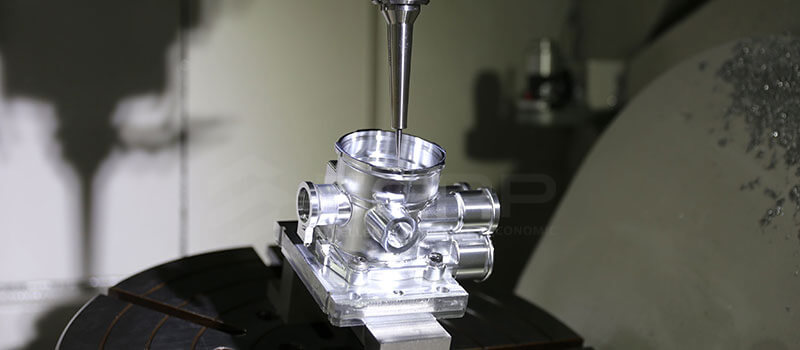
2026 global engineering and procurement teams show four high-frequency search demands around 5-axis machining: single-setup full-part fabrication, elimination of tolerance stack-up, processing superalloys/titanium, and automated pallet mass production. General 3-axis machine shops can only split complex multi-angle parts into 4–8 separate fixtures, which brings three unavoidable losses: long production cycles, accumulated dimensional errors after repeated clamping, and expensive custom fixture fees.
Industry data shows complex parts produced by multiple 3-axis setups will accumulate ±0.01~0.03mm datum deviation, directly causing assembly failure for aerospace turbine blades and medical implants. Meanwhile, many small manufacturers lack professional DMG Mori and Mazak 5-axis equipment, unable to machine continuous curved surfaces such as impellers and eccentric shafts. This is why professional 5-axis machining has become a mandatory supply chain link for high-tech OEMs in 2026.
As an ISO 9001 certified full-spectrum manufacturer, ProtoTech deploys a complete fleet of imported 5-axis machining centers, supporting simultaneous 5-axis linkage and automated pallet unmanned production. This guide combines industry hot pain points and site internal resources to explain how 5-axis technology completely subverts traditional multi-fixture processing modes.
2. What Is Simultaneous 5-Axis Machining & RTCP Core Technology
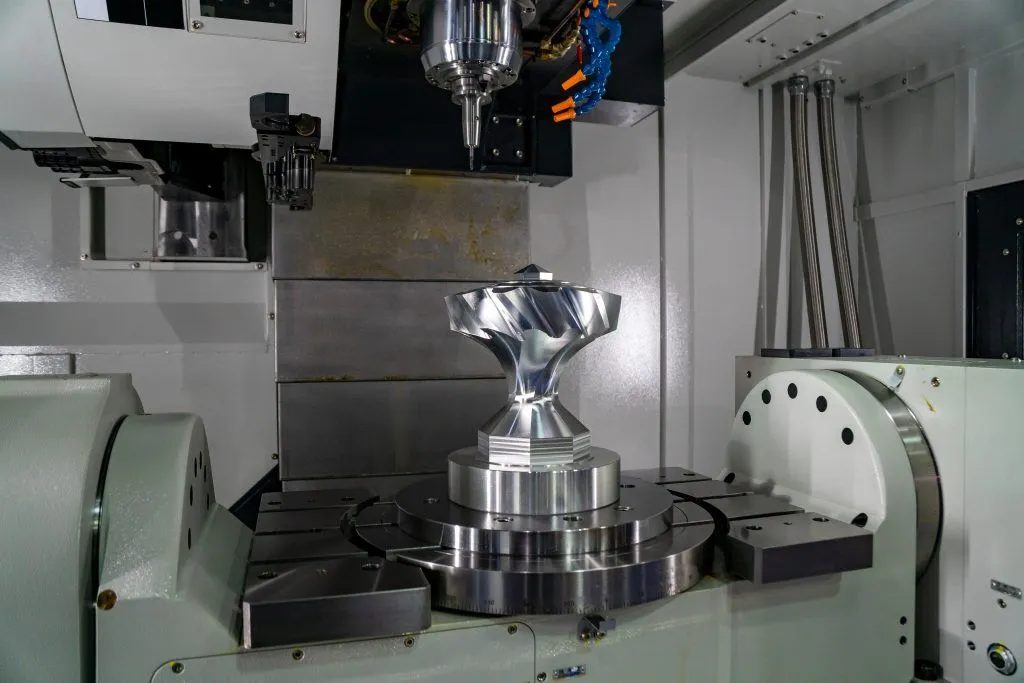
Unlike 3-axis machines limited to X/Y/Z linear movement, full simultaneous 5-axis machining adds two independent rotary axes (B/C or A/C), allowing the cutting tool to reach any workpiece surface at the optimal angle at all times抖音. The core technical guarantee of stable precision is RTCP real-time tool center point compensation: when the rotary axis tilts the spindle, the CNC system automatically offsets linear coordinates to keep the tool tip locked on the target machining point, avoiding dimensional drift caused by angle changes.
There are two mainstream 5-axis modes widely used on the market:
- 3+2 Index 5-Axis: Lock rotary axes after angle positioning, only 3-axis cutting. Suitable for multi-plane prismatic parts with no continuous curved surfaces, lower processing cost.
- Full Simultaneous 5-Axis: Five axes move synchronously throughout cutting. Mandatory for sculptured surfaces, impellers, turbine blades, deep undercut cavities.
All DMG Mori and Mazak equipment on the 5-axis machining service page supports both modes. Our CAM engineers will automatically match the optimal linkage mode according to your CAD geometry during free DFM analysis to balance cost and precision.
3. 3-Axis vs 3+2 Index vs Full Simultaneous 5-Axis Comparison Table
This comparison table solves the most confusing question for engineers: which machining solution should I choose for my design?
| Comparison Item | Standard 3-Axis Milling | 3+2 Index 5-Axis | Full Simultaneous 5-Axis |
|---|---|---|---|
| Rotary Axis Support | None | Discrete angle lock | Continuous synchronous rotation |
| Minimum Setup Count | 4–8 times for 6-sided parts | 1–2 setups | Single one-time clamping |
| Tolerance Stack-Up | Severe cumulative error | Minor datum shift | Almost zero deviation |
| Suitable Geometry | Flat, simple single-face parts | Multi-angle brackets, angled holes | Impellers, turbine, organic curved surfaces |
| Tool Length Requirement | Long extended tools (chatter risk) | Medium short rigid tools | Shortest optimal tool angle |
| Average Cycle Time | Long repeated clamping waiting | Medium | Shortest, one-time forming |
| Typical Hour Cost | Low | Medium | Slightly higher, saves fixture expense |
| Core Industry Match | Consumer hardware housings | Automotive structural brackets | Aerospace, medical implants, energy turbines |
Even though simultaneous 5-axis equipment has higher hourly rates, the total project cost can be reduced by 30% after deducting custom fixture and rework expenses, which is the core value highlighted by ProtoTech’s service data.
4. Full Equipment Fleet & Production Capacity on ProtoTech 5-Axis Machining
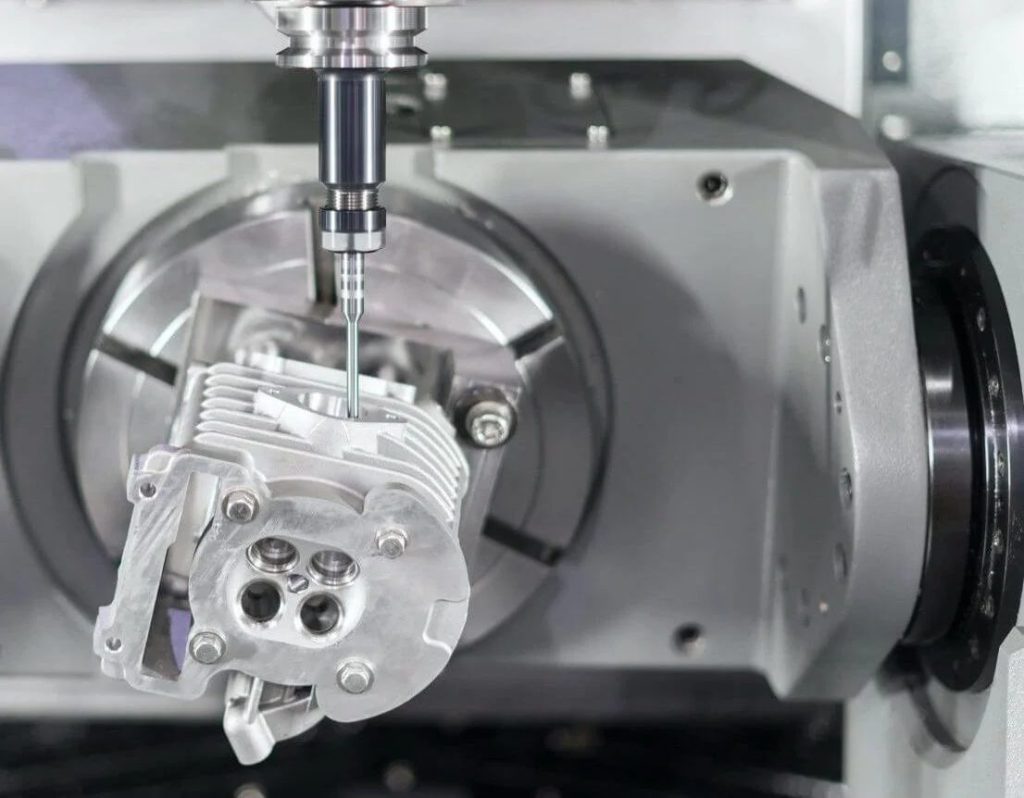
The site’s dedicated 5-axis workshop is equipped with top-tier imported brand machines, divided into automated pallet production cells and large travel machining units to cover all size requirements:
- Mazak HCR-5000 Automated Cell
- 18 pallet queue system supporting unattended lights-out production
- Work envelope: 28.74” × 28.74”
- Mainly for small and medium batch aluminum complex prototypes
- DMG Mori CTX TC 6-Sided Machining Centers (4 Units)
- Max travel: 120.1” × 27.5”, large heavy alloy blanks
- Realize full 6-sided complete processing in one setup, eliminate secondary clamping
- Mazak INTEGREX i-400 Multi-Task 5-Axis Lathes (3 Units)
- Combine turning and 5-axis milling in one machine for rotary complex integrated parts
- Chuck size up to 12”, suitable shaft-impeller integrated components
Supported workpiece overall envelope reaches 27.5” × 120”, covering small medical micro implants to large aerospace structural castings/forgings. The equipment daily calibration system guarantees consistent precision for prototype to 10,000 mass batches, fully complying with ISO 9001 quality control standards.
5. All Machinable Materials & Full Process Range for 5-Axis Projects
Machinable Raw Materials
Covers all mainstream metal blanks, castings, forgings and engineering plastics:
- Superalloys: Inconel, Hastelloy, Waspaloy, Monel, Invar
- Light metals: Aluminum 6061/7075, titanium Ti-6Al-4V
- Stainless & alloy steel: 304/316, armor plate, Nitralloy, Stellite
- Copper, brass, bronze, powdered metal blanks
- Engineering plastics: PEEK, PC, nylon, ABS
Complete In-House 5-Axis Processing Operations
Boring, broaching, counterboring, countersinking, multi-angle drilling, complex 3D pocketing, contour profiling, gear hobbing, spline machining, internal/external threading, knurling, turning contour compound machining, deep undercut forming.
After 5-axis forming, all parts can be directly sent to our Surface Finishing workshop for anodizing, electropolishing, nickel plating, bead blasting and laser marking without cross-vendor transit.
6. Industry-Specific 5-Axis Application Scenarios & Design Standards
Aerospace & Defense (Highest Demand Vertical in 2026)
Core parts: Turbine blades, engine impellers, lightweight monolithic structural brackets, missile guidance complex housings.
Design standard: Continuous aerodynamic curved surfaces, tight positional tolerances ±0.01mm, single-setup full forming to avoid flight safety risks caused by datum errors.
Medical Equipment & Implants
Core parts: Custom orthopedic implants, surgical instrument multi-angle handles, dental complex abutments.
Design standard: Biocompatible titanium alloy, ultra-smooth surface Ra ≤0.4μm, no sharp residual tool marks, no secondary clamping micro-deformation.
Oil, Gas & Power Generation
Core parts: Energy pump impellers, turbine flow control components, high-pressure multi-angle valve bodies.
Design standard: Deep internal flow channels, compound-angle sealing surfaces, wear-resistant superalloy machining.
Automotive EV & Heavy Equipment
Core parts: New energy motor impellers, racing aerodynamic molds, multi-angle suspension brackets.
Design standard: Large batch automated pallet production, balanced cost and precision for mass prototype verification.
All industry case sample parts are displayed in the gallery on the 5-axis machining landing page, with real finished impeller and bracket photos for client reference.
7. How Single-Setup 5-Axis Cuts Lead Time & Hidden Fixture Costs
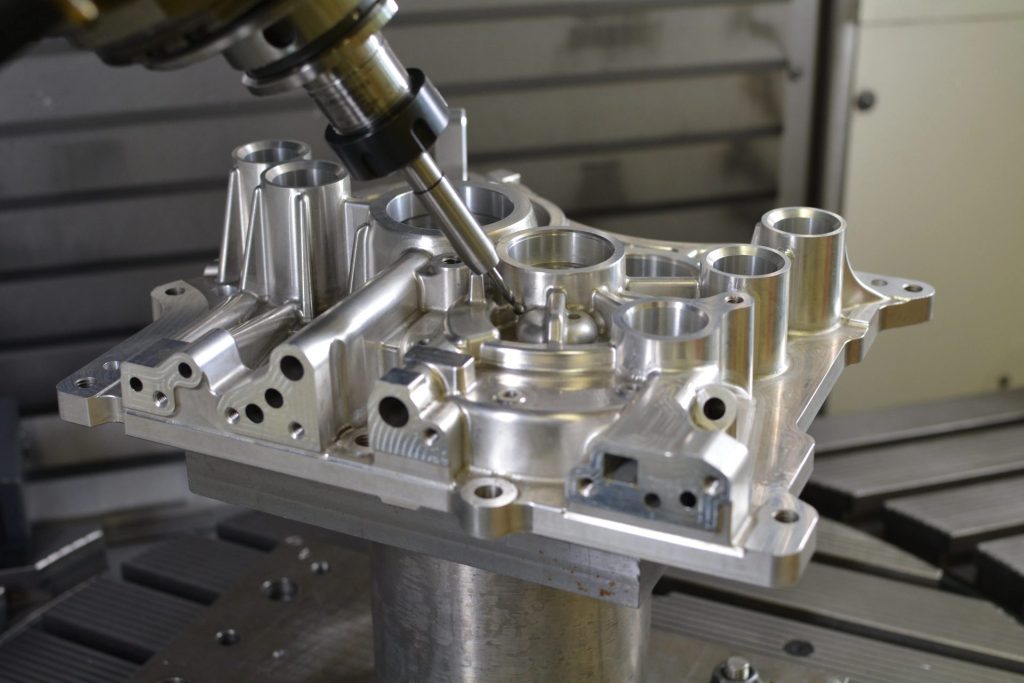
Two biggest invisible costs of traditional multi-fixture 3-axis processing are custom fixture manufacturing fees and repeated clamping waiting time, both completely eliminated by ProtoTech’s simultaneous 5-axis single-setup solution:
- Fixture Cost Elimination Complex multi-angle parts need 3–6 custom aluminum fixtures for 3-axis processing; 5-axis only requires one simple base clamping tab, saving thousands of fixture production expenses for each project.
- Lead Time Compression 4–6 times clamping and re-alignment work is cut to one single loading/unloading step, shortening total manufacturing cycle by 40%–60% for complex components.
- Scrap Rate Reduction Every re-clamp brings positioning deviation; single-setup RTCP linkage controls geometric tolerance consistency, scrap rate of complex curved parts drops below 2%.
Combined with the 18-pallet Mazak unmanned production line, small batch prototype orders can be completed and delivered in as fast as 3 working days, matching the fast quotation promise of the whole site.
8. DFM Design Tips to Avoid Common 5-Axis Machining Scrap Risks
Based on thousands of 5-axis project cases at ProtoTech, five design mistakes most easily cause tool collision, chatter and scrap, with targeted optimization suggestions:
- Excessively thin wall thickness Risk: Vibration during high-speed linkage leads to surface ripple; Fix: Aluminum ≥1mm, steel/titanium ≥1.5mm minimum wall.
- Zero-radius internal sharp corners Risk: Ball endmill cannot reach full corner, leaving residual material; Fix: Add ≥1mm internal fillet radius.
- Deep narrow pockets with depth over 5× tool diameter Risk: Long slender tools vibrate severely, poor surface finish; Fix: Widen pocket opening or add step relief layers.
- Missing dedicated clamping datum flats Risk: Unstable workpiece shaking during 5-axis rotation; Fix: Reserve small sacrificial clamping tabs removable after finishing.
- Overly tight tolerances on non-functional surfaces Risk: Extended finishing cycle raises unit price sharply; Fix Only mark ±0.005~0.01mm tight tolerance on mating sealing surfaces.
Our engineering team will list all DFM optimization suggestions for free in the quotation feedback when clients upload CAD files to the homepage RFQ portal.
9. Cross-Service Synergy: Pair 5-Axis With Other CNC Lines
As a one-stop manufacturing platform, ProtoTech matches 5-axis machining with other core services to complete full assembly parts in a single order:
- Match With CNC Milling: Simple flat base plates + 5-axis complex curved core components for full equipment housings.
- Match With Swiss CNC Machining: Large 5-axis machined valve bodies + micro Swiss turned pin connectors for fluid control assemblies.
- Match With CNC Turning: Rotary shaft blanks + 5-axis multi-angle blade contour machining for integrated impeller shafts.
- Match With Tungsten Alloy Machining: High-density radiation shielding complex curved blocks with specialized low-stress 5-axis cutting parameters.
Unified single-RFQ bundled orders save separate shipping and communication costs between multiple suppliers, with average overall project expenditure reduced by 30%.
10. Complete End-to-End RFQ & Manufacturing Workflow
- Visit the ProtoTech homepage and upload STEP/IGES CAD drawings, mark material, tolerance, surface finish and batch quantity.
- Professional 5-axis CAM engineers launch free DFM review, identify collision risks and design optimization points, deliver formal quote within 3 hours.
- Confirm order; raw blanks are loaded onto DMG Mori / Mazak 5-axis cells, adopt simultaneous 5-axis or 3+2 linkage per design demand.
- Multi-stage in-process CMM dimensional inspection to monitor geometric tolerance and surface finish.
- Transfer parts to surface finishing workshop for plating, anodizing or polishing as required.
- Final full quality audit, shockproof customized packaging and global delivery within 1–2 weeks for small batches.
- All orders covered by the official 30-day quality rework & refund guarantee for non-conforming 5-axis parts.
11. Frequently Asked Questions About 5-Axis Machining
Q1 What’s the difference between 3+2 index 5-axis and full simultaneous 5-axis at ProtoTech?
3+2 locks rotary axes after positioning, suitable for multi-angle flat holes and brackets with low cost; simultaneous 5-axis supports continuous curved surface linkage for impellers, turbine blades, covered fully on our 5-axis machining page. Our engineers select the optimal mode automatically during DFM analysis.
Q2 What maximum part size can your 5-axis centers process?
The DMG Mori large travel model supports a workpiece envelope up to 27.5” × 120”, covering small medical implants to large aerospace monolithic castings.
Q3 Can 5-axis machining process hard superalloys like Inconel and titanium?
Yes. Our machine fleet is equipped with heavy-duty high-torque spindles and dedicated superalloy cutting tool libraries, with mature low-vibration 5-axis toolpaths for heat-resistant aerospace alloys.
Q4 Is there a minimum order quantity for 5-axis machining projects?
No MOQ restrictions. We accept single prototype impeller samples all the way to 10,000-unit automated pallet mass production batches.
Q5 Does single-setup 5-axis eliminate all positioning tolerance errors?
Nearly zero datum shift compared to repeated 3-axis clamping; RTCP real-time tool point compensation ensures consistent geometric precision across all workpiece surfaces machined in one clamping.
12. Final Sourcing Tips for Complex Multi-Face Components
- Clarify whether your design contains continuous curved aerodynamic surfaces at the quotation stage to avoid mismatched 3-axis processing solutions.
- Reserve simple clamping datum tabs on CAD drawings to reduce fixture design time and extra processing fees.
- Distinguish functional critical surfaces and non-cosmetic areas to avoid unnecessary ultra-tight tolerance markup.
- Combine 5-axis complex core parts with standard turning/milling accessories into one RFQ for bundled volume discounts.
- Choose suppliers with imported DMG Mori / Mazak 5-axis equipment instead of domestic low-end 5-axis machines to guarantee long-term batch consistency.
In the 2026 high-tech manufacturing market where complex curved multi-angle parts become mainstream, single-setup simultaneous 5-axis machining is no longer a high-end luxury but a necessary solution to control lead time, scrap rate and hidden fixture costs. The professional 5-axis machining service at ProtoTech Machining relies on imported brand equipment, full material compatibility and free DFM optimization to deliver reliable complex components for aerospace, medical, energy and automotive global manufacturers. Upload your 3D CAD files today to get a customized quotation and manufacturability analysis within three hours.